
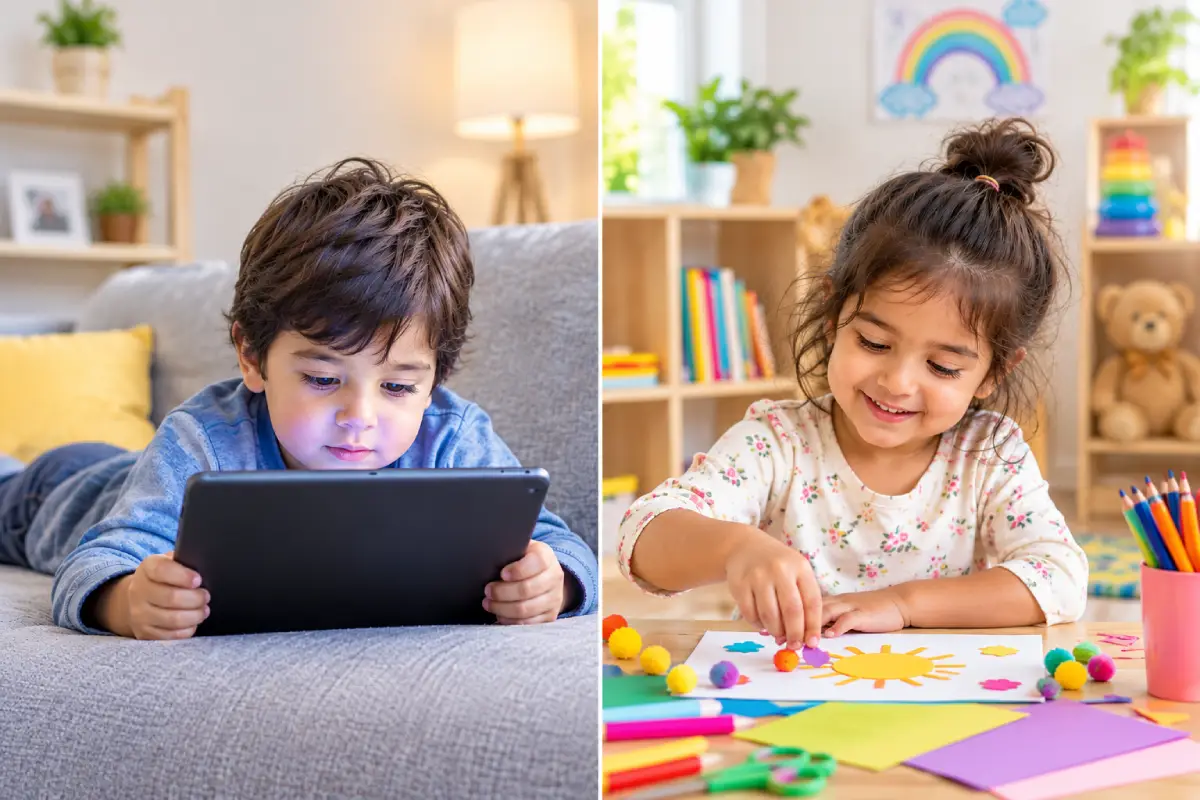
Keeping toddlers entertained at home can sometimes feel like a full-time job. Young children are naturally curious, energetic, and eager to explore, but parents may not always have the time or energy to plan new activities throughout the day. When a phone, tablet, television, or other screen is easily available, it can quickly become the simplest way to keep a toddler occupied.
Screens are not necessarily bad, but too much passive screen time can take away opportunities for toddlers to move, explore, imagine, communicate, and create. This is where creative time becomes important. Simple activities such as drawing, building, pretend play, music, puzzles, and sensory play can turn ordinary time at home into an opportunity for learning and discovery.
The goal is not to eliminate screens completely. Instead, parents can create a healthy balance between screen time and meaningful activities that encourage toddlers to participate actively.
Understanding Screen Time and Creative Time
Screen time refers to time spent watching or interacting with digital devices such as televisions, smartphones, tablets, computers, and gaming devices. Depending on the content and how it is used, screen time can sometimes provide educational or entertaining experiences.
Creative time, on the other hand, involves activities where children actively use their imagination, senses, movement, and problem-solving abilities. Drawing a picture, building a tower with blocks, making something with clay, pretending to run a shop, or dancing to music are all examples of creative play.
The biggest difference is active participation. During creative activities, toddlers make choices, experiment, communicate, and use their imagination rather than simply consuming content.
Why Creative Time Matters for Toddlers
1. Encourages Imagination
Creative play gives toddlers the freedom to invent their own stories and situations. A cardboard box can become a car, a blanket can become a tent, and a group of toys can become characters in an imaginary story.
This type of open-ended play allows children to use their imagination without always needing instructions.
2. Builds Problem-Solving Skills
Simple activities can encourage toddlers to think about how things work.
For example, while building a block tower, a child may discover that placing larger blocks at the bottom makes the structure more stable. These small discoveries introduce problem-solving in a natural and enjoyable way.
3. Supports Fine Motor Development
Activities such as colouring, tearing paper, playing with playdough, stacking blocks, and putting together simple puzzles require toddlers to use their hands and fingers.
Regular opportunities to practise these movements can help children develop coordination and control.
4. Encourages Communication
Creative activities can create natural opportunities for parents and children to talk.
While drawing, for example, parents can ask questions such as:
- “What are you drawing?”
- “What colour would you like?”
- “Who lives in this house?”
- “What happens next in your story?”
These conversations can encourage vocabulary development and self-expression.
5. Promotes Independent Play
Toddlers do not need adults to organise every minute of their day. Providing safe, age-appropriate materials and allowing children to explore them independently can gradually help them become more comfortable playing on their own.
Independent play can also give parents a little time to complete everyday tasks while keeping the child engaged.
Simple Creative Activities to Try at Home
Creative activities do not have to be expensive, complicated, or Pinterest-perfect. Some of the best toddler activities can be made using things already available at home.
1. Drawing and Colouring
Give your toddler crayons, washable markers, or child-safe colouring materials along with paper.
Instead of focusing on creating a perfect picture, let your child experiment with colours, lines, circles, and shapes.
You can also turn drawing into a conversation by asking your child to explain what they have created.
2. Build With Blocks
Blocks, stacking cups, and similar toys can provide hours of simple entertainment.
Ask your toddler to build a tall tower, make a small house, or create a road for toy cars. You can also let them knock everything down and start again.
The activity is simple, but it encourages coordination, creativity, and problem-solving.
3. Create a Pretend-Play Corner
Pretend play is one of the easiest ways to encourage imagination.
Set up a small space where your child can pretend to be:
- A doctor
- A shopkeeper
- A chef
- A teacher
- A firefighter
- A parent caring for a doll
- A restaurant owner
Everyday household objects can often become props for imaginative play.
4. Make a Cardboard Box Activity
Before throwing away a large cardboard box, consider turning it into a play activity.
With adult supervision, a box can become a pretend house, car, shop, rocket, or animal home.
Children can decorate it using crayons, stickers, or washable colours. The process of deciding what the box will become is often just as enjoyable as playing with it afterward.
5. Play With Playdough
Playdough can encourage toddlers to squeeze, roll, flatten, pinch, and shape materials.
Parents can suggest simple ideas such as making:
- Balls
- Snakes
- Flowers
- Fruits
- Animals
- Simple shapes
Always choose age-appropriate materials and supervise young children during play.
6. Have a Music and Dance Session
Creative time does not always need to involve sitting at a table.
Play a few child-friendly songs and encourage your toddler to dance, clap, jump, or move like different animals.
You can also give them simple household-safe instruments such as child-friendly shakers or drums.
Music and movement can make children more active while giving them another way to express themselves.
Quality Time Matters More Than Perfect Activities
Parents sometimes worry that they need to constantly provide educational toys or elaborate activities. In reality, toddlers can learn from very simple experiences.
Talking while preparing food, reading a book together, building a tower, singing a song, watering plants, or taking a short walk can all become meaningful opportunities for learning.
The goal is not to make every minute educational. It is to create opportunities for children to explore, interact, move, imagine, and connect with the people around them
Keeping toddlers engaged at home does not require expensive toys, complicated activities, or hours of planning. Small changes can make a meaningful difference. By creating opportunities for drawing, building, reading, pretend play, music, movement, and exploration, parents can help children spend more time actively participating in their surroundings. These simple activities can also make everyday moments more meaningful, much like the approach to real-life learning experiences that encourages children to learn through observation, participation, and exploration.
Screen time may have a place in a family’s routine, but it does not have to become the default solution whenever a toddler feels bored. With a little creativity and a simple routine, everyday moments at home can become opportunities for children to learn, imagine, communicate, and have fun. For families looking for a supportive environment where young children can learn through play, interaction, and exploration, Elzee Preschool & Daycare provides a child-centred approach to early learning.